
Are Garden Rooms Cold in Winter? How to Keep One Warm (and What It Costs)
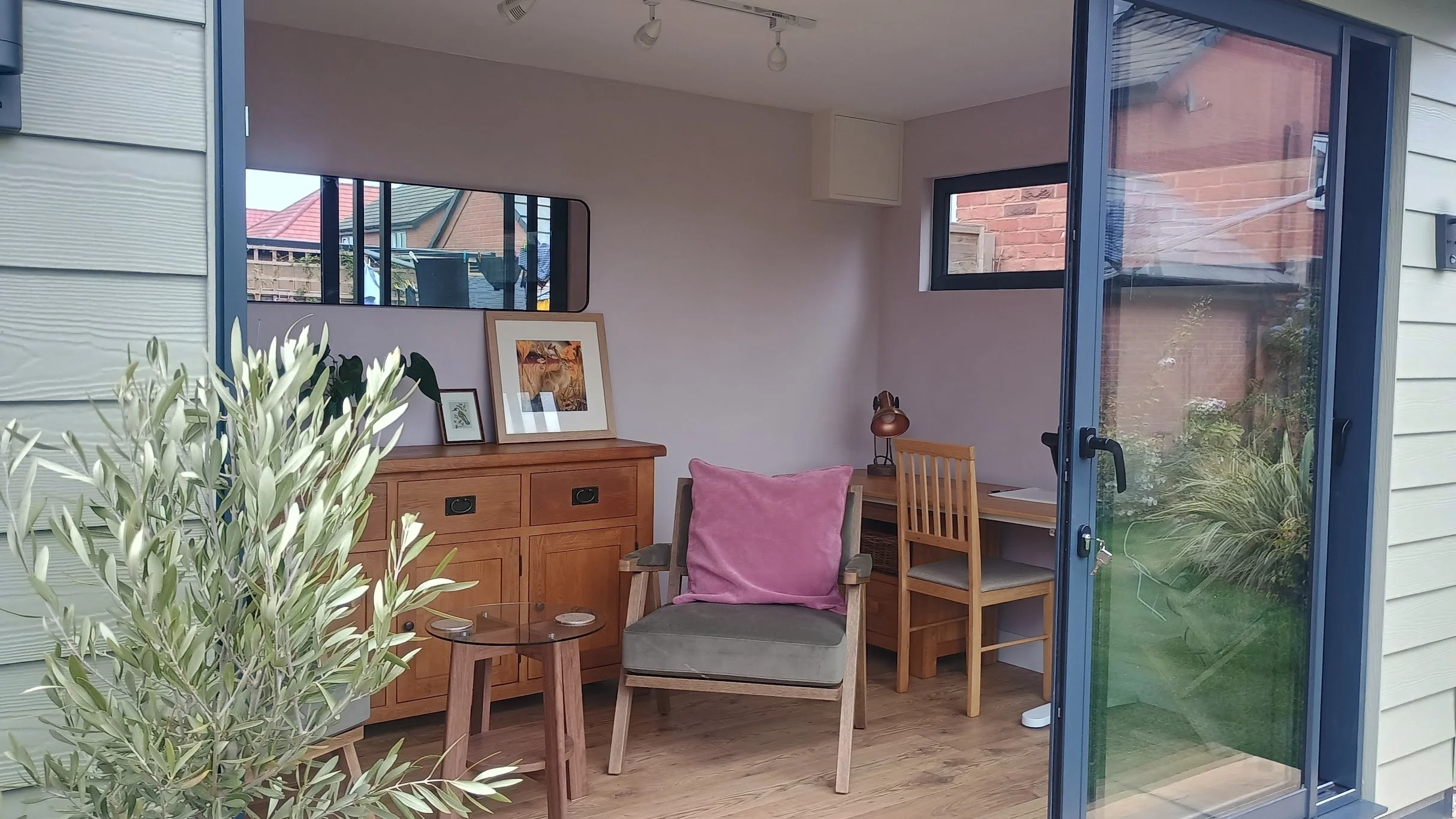
A well-built garden room stays warm through an English winter on a small electric heater. A poorly built one stays cold however hard the heater works. So are garden rooms warm in winter? The answer depends almost entirely on how the floor, walls, roof and glazing were put together, and very little on the heating you add afterwards.
That matters more than most buyers realise, because the majority of garden rooms in England don't need Building Regulations approval. Without it, there's no minimum standard for how well they're insulated. Two buildings can both be described as "fully insulated" and feel completely different on a frosty January morning.
We're a family business building garden rooms across Oxfordshire, and in this guide we'll explain where heat escapes from a garden room, what a good specification looks like in real numbers, what it costs to heat one at today's electricity prices, and the questions worth asking any builder before you commit.
Why some garden rooms are cold in winter, and others aren't
A room in your house is surrounded by other warm rooms. A garden room has cold air on every side, above it and underneath it, so every surface is losing heat at once. For the amount of space inside, it has a lot of outside surface, which makes it far less forgiving of shortcuts.
Heat leaves through five main routes. The floor is the one people forget, and a cold floor makes a room feel chilly even when the air is at a comfortable temperature. The roof loses heat because warm air rises. The glazing is usually the weakest part of the walls, and garden rooms tend to have a lot of it. The joins between panels, and between the walls, floor and roof, can let heat bypass the insulation completely. Then there are draughts around doors, windows and service entry points.
A garden room that feels cold in winter usually has a weakness in one or two of these places. That's why a bigger heater rarely fixes it. The heat simply escapes faster, and you pay for it.
The rule most garden room buyers don't know about
According to the Planning Portal, a detached outbuilding normally doesn't need Building Regulations approval if it's under 15 square metres and has no sleeping accommodation. Between 15 and 30 square metres, it normally doesn't need approval either, as long as there's no sleeping accommodation and it's at least one metre from any boundary or built substantially from non-combustible materials. Most garden offices and studios fall within those limits.
It's a sensible exemption, and it keeps garden rooms affordable and quick to build. It also means Part L, the section of the regulations that sets insulation standards for homes, doesn't apply. Nothing requires a garden room to be insulated to any particular level, so "insulated" on a quote could mean almost anything.
The useful yardstick is the standard for home extensions. Approved Document L sets limiting U-values for new walls, roofs, floors and windows in extensions. A U-value measures how much heat passes through a surface, and the lower the number, the less heat you lose.
| Part of the building | Extension standard (U-value, W/m²K) |
|---|---|
| Walls | 0.18 |
| Roof | 0.15 |
| Floor | 0.18 |
| Windows and glazed doors | 1.4 |
A garden room doesn't have to meet these figures, but asking a builder how close theirs comes is one of the quickest ways to compare quotes properly. You can read more about the planning side in our guide to garden room regulations in Oxfordshire.
Electrics are treated differently. Running a new circuit out to a garden room is notifiable work under Part P of the Building Regulations, so it should always be done by a registered electrician who can certify it.
What a fully insulated garden room should include
A fully insulated garden room has insulation in the floor, the walls and the roof, with the joins between them sealed and the glazing chosen to match. Leaving out any one of those undoes much of the good work in the others.
Walls and roof
There are a few ways to build an insulated wall. A timber frame filled with insulation between the studs is common and works well, though each stud is a small path for heat to bypass the insulation. Structural insulated panels, usually called SIPs, take a different approach. Each panel is a solid core of insulation bonded between two structural boards, so the insulation runs continuously across the whole wall or roof. The Structural Timber Association describes SIPs as "free from the complications of thermal bridging" and capable of producing "highly airtight, energy-efficient building envelopes".
On quotes you'll also see insulation materials named, such as PIR board, mineral wool or sheep's wool. Each performs differently for its thickness, which is why a U-value tells you more than a material name or a thickness on its own.
The floor
The floor sits over a gap of cold, moving air, and it's the surface you're in contact with all day. An uninsulated or thinly insulated floor is the most common reason a garden office feels cold around the ankles while the thermostat says the room is warm. Ask specifically what's under the floor deck and how thick it is.
Glazing and doors
Double glazing should be the minimum for a garden room you plan to use in winter. Single-glazed garden buildings lose heat quickly and are prone to condensation, which makes them better suited to summer use. Look for windows and glazed doors that come close to the 1.4 W/m²K figure in the table above.
Glass works in both directions. Large south-facing doors bring welcome warmth on a bright winter day and can make a room uncomfortably hot in July. If you're planning a lot of glazing, it's worth reading our guide to keeping a garden office cool in summer at the same time.
Seals and airtightness
A well-insulated wall loses much of its value if cold air can find its way around it. Good builders seal the joins between panels, fit doors and windows with proper seals, and make sure cables and pipes enter through sealed points. An airtight room also needs a controlled way for fresh air to get in, which we come back to in the section on condensation.
How we build Aybel garden rooms for winter
Before we built a garden room for anyone else, Simon and Angie tested our buildings in their own garden. The specification we use today came out of that, and it's designed for a room you'll use every month of the year.
Our walls and roof are built from SIPs, which give continuous insulation with very few gaps for heat to escape through. The roof is finished with a single sheet of EPDM rubber membrane, so there are no seams for water to find, and the outside is clad in ThermoWood pine from sustainably certified forests. Inside, the walls are battened to create an air gap, then plasterboarded and finished smooth.
Every door and window is double-glazed uPVC with multipoint locking. Each room comes with a wall-mounted heater as standard , and you can choose underfloor heating or Wi-Fi controlled heating if you'd like more control. We use ground screw foundations, which are quick to install and avoid the need for a concrete base.
Every build is covered by a 10-year insurance-backed structural guarantee. If you'd like to see the detail, our full specification sets it all out, and you can see finished examples among our garden office builds.
How to heat a garden room: the options compared
In a well-insulated garden room, the heating has an easy job. It brings the room up to temperature, then switches on and off to top up the small amount of heat that escapes. That's why we'd always look at the building first and choose the heater second. The main options are below.
| Heating | How it works | Best for | Worth knowing |
|---|---|---|---|
| Wall-mounted electric panel heater | Warms the air, controlled by a thermostat | Most garden offices and studios | Simple, low cost to fit, and very effective in a well-insulated room |
| Infrared panel | Warms people and surfaces directly, rather than the air | Rooms used in short bursts | Feels warm quickly, though the air temperature stays lower |
| Electric underfloor heating | Thin heating mats beneath the floor finish | Rooms used all day, and anyone who feels the cold in their feet | Even, gentle warmth with no wall space taken up. Best fitted during the build |
| Air-to-air heat pump | A wall unit inside and a small fan unit outside move heat into the room | Larger rooms and heavy all-year use | Can cool the room in summer too. Higher upfront cost, and the outdoor unit needs a sensible spot |
| Portable heater | Plug-in fan, oil-filled or convector heater | Stop-gap use only | Easy to buy, but usually the most expensive way to heat a room for long periods |
| Wood burner | A small stove with a flue through the roof | Garden rooms used for relaxing rather than working | Needs a HETAS-registered installer for the flue, hearth and clearances. In a smoke control area you can only use approved fuels or a Defra-exempt stove, so check with your local council |
On heat pumps, the Energy Saving Trust notes that they're more than three times more efficient than a gas or oil boiler, and that air-to-air systems are more often used in smaller spaces. For a garden room used as a full-time office, that efficiency and the option of cooling in summer can make one worth considering.
Every room we build comes with a wall heater as standard. Underfloor heating is the upgrade we'd suggest for anyone who'll be sitting at a desk for long stretches.
What does it cost to heat a garden room in winter?
Working out the cost of heating a garden room is simple arithmetic. Multiply the heater's power in kilowatts by the number of hours it runs, then by the price you pay for each unit of electricity.
Under the Ofgem energy price cap for 1 October to 31 December 2026, the average electricity unit rate for direct debit customers is 26.32p per kWh. A 2kW heater running at full power for an hour uses 2kWh, which costs about 53p. Across an eight-hour working day, that comes to about £4.21.
That figure is the ceiling. A heater with a thermostat only runs at full power while the room warms up. After that it cycles on and off to hold the temperature, and how often it needs to come on depends on how quickly the room loses heat. In a well-insulated room that can be a fraction of the hour, and in a poorly insulated one the heater may barely switch off at all, so the build makes the biggest difference to what you pay.
The same sum works for any heater and any tariff, so you can check it against your own bill. Prices correct as of October 2026.
Condensation and damp in winter
Cold isn't the only winter problem. Every time you breathe, boil a kettle or hang up a wet coat, you add moisture to the air, and that moisture turns to water on the coldest surface it can find. In a garden room that's often the glass, the corners of the ceiling or the back of a cupboard against an outside wall. Left alone, it leads to mould, damp smells and, over time, damage to the timber.
Garden room condensation is managed in three ways. A vapour control layer on the warm side of the insulation stops moist air from reaching the cold parts of the wall and roof. Some ventilation, such as trickle vents in the windows or a small extractor, lets moist air out without letting the heat go with it. And a low background temperature on a thermostat or timer keeps surfaces above the point where condensation forms, rather than letting the room drop to freezing between uses and then heating it quickly. If you keep a computer, printer or paperwork in a garden office, that steady background warmth protects them too.
Already have a cold garden room? What you can improve
If you already own a garden room that's hard to keep warm, some fixes are cheap and quick. Others are major work. Roughly in order of cost:
Draught-proof the doors and windows. New seals and brush strips are inexpensive and often make a noticeable difference.
Fit a programmable thermostat. Heating the room before you arrive and holding a low background temperature costs less than warming it from cold every morning.
Add thermal curtains or blinds. They cut heat loss through the glass at night and on dull days.
Cover the floor. A thick rug or an insulated floor finish helps if the floor is the problem.
Insulate the roof or floor. Often possible from inside or underneath, depending on how the room was built.
Upgrade the glazing. Replacing single glazing with good double glazing is a bigger job, but it tackles one of the main routes for heat loss.
Insulating the walls of a finished garden room is the hardest retrofit of all, because it usually means stripping the inside back to the frame. In some cases the cost comes close to that of a new building, so it's worth getting an honest opinion before you start.
Questions to ask a garden room builder about winter comfort
Whoever you choose to build your garden room, these questions will tell you a lot about how it'll feel in January:
What are the U-values for the walls, roof, floor and glazing?
What insulation goes into each of those, and how thick is it?
How are the joins between panels, and between the walls, floor and roof, sealed?
What heating is included, and how powerful is it?
How is the room ventilated to prevent condensation?
Is the electrical work carried out and certified by a registered electrician?
What does the guarantee cover, and for how long?
A builder who's confident in their specification will answer every one of these without hesitation.
Frequently asked questions
Can you use a garden room all year round?
Yes, as long as it's properly insulated in the floor, walls and roof, double-glazed and fitted with heating. A garden room built to that standard can be used every day through winter as an office, studio or gym. Buildings with thin insulation or single glazing are usually only comfortable from spring to autumn.
Do garden rooms need heating?
For regular use between October and April, yes. Even a very well-insulated garden room needs a heat source, because there's no warmth coming through from neighbouring rooms the way there is in a house. Good insulation means a small heater is enough and keeps running costs low.
Are single-glazed garden buildings suitable for winter use?
Not really. Single glazing loses heat quickly and the glass gets cold enough for condensation to form on it most winter mornings. If you plan to use a garden building in winter, double glazing should be the minimum.
Can I put a heat pump in a garden room?
Yes. An air-to-air heat pump, with an indoor wall unit and a small outdoor unit, can heat a garden room efficiently and cool it in summer. The upfront cost is higher than an electric heater, so it tends to suit larger rooms or ones used every day.
Do I need Building Regulations approval to heat a garden room?
The garden room itself usually doesn't need approval if it meets the size and boundary conditions set by the Planning Portal. The electrics are different. A new circuit to a garden room is notifiable work, so it should be installed and certified by a registered electrician. A wood burner should be fitted by a HETAS-registered installer.
Warm in January, comfortable in July
Whether you'll use your garden room on a dark January afternoon comes down to decisions made long before you plug in a heater. The floor, the walls, the roof, the glazing and the care taken over every join between them decide how the room feels in winter, and how much it costs to keep it that way.
If you're thinking about a garden room in Oxfordshire and want to talk through how we'd build yours, including the specification and how we'd heat it, we'd be glad to hear from you. Get in touch and we'll take it from there.
